Wednesday, January 13, 2016

Oxford: Where time is fluid

Here's a great article from the Washington Post that describes Oxford perfectly.

Oxford: Where time is fluid, Latin is far from dead and every stone tells a story


FROM THE WASHINGTON POST  -- WRITTEN BY DIANE ROBERTS

In Oxford, England, past and present run together like watercolor. Students texting as they saunter down the High Street wear long black academic gowns that have barely changed since the 13th century. You can get a mojito in pubs that predate the invention of rum by 300 years. And Oxford dons (from the Latin “dominus,” meaning lord or master: what university faculty are called) never seem to age. I figure it’s the wine.


Time is fluid there. Oxford, located one degree, 15 minutes and 24 seconds west of the prime meridian at Greenwich, is technically 5 minutes and 2 seconds behind. But when it’s 9:05 p.m. in the rest of Great Britain, Great Tom, a six-ton bell in the gate tower of Christ Church College, tolls — not nine times to mark the hour, which would make some kind of sense, but 101 times. See, in 1663, Christ Church had 101 students. Curfew was 9 p.m. Ergo, 101 peals every night ever since, calling those old ghosts, telling them to get out of the pub and into bed.


Not that the rest of the city follows Christ Church’s lead. Each college, each church, richly endowed with bells, has its own time. They ring out the hour, the quarter hour and the half hour a few minutes either side of what your modern, synchronized watch says, making the city sound as though it’s in a perpetual state of celebration. Stephen Hawking, the great physicist who probably knows more than anyone about the tricky ways of space and time, was born in Oxford and did his undergraduate work here. So did that noted mathematician-turned-writer Lewis Carroll:


“If you knew Time as well as I do,” said the Hatter, “you wouldn’t talk about wasting it. It’s him.”
“I don’t know what you mean,” said Alice.“Of course you don’t!” the Hatter said, tossing his head contemptuously. “I dare say you never even spoke to Time!”“Perhaps not,” Alice cautiously replied: “but I know I have to beat time when I learn music.”“Ah! that accounts for it,” said the Hatter. “He won’t stand beating. Now, if you only kept on good terms with him, he’d do almost anything you liked with the clock.”


I lived in Oxford for 10 years, as an undergraduate, graduate student and, once I finished my doctorate, a lecturer. I never owned a watch; I let the bells guide me. Now I come back whenever I can, preferably during term time, when the city is most itself, full of bicycles and students. The university has three terms a year, named for ecclesiastical seasons: Michaelmas, Hilary and Trinity, each of which officially last for eight weeks but really go on for 10, beginning with 0th Week, pronounced “noughth,” rhyming with moth, and ending with 9th.


Confusing? Welcome to Oxford: Every stone has a story and language is shifty. As Humpty Dumpty said to Alice, “When I use a word, it means just what I choose it to mean — neither more nor less.”


Something for everyone


Oxford draws pilgrims to sites both secular and sacred. Some drink a reverent pint in the Eagle and Child, the pub where C.S. Lewis and J.R.R. Tolkien, taking a break from inventing magical lands, used to knock back a few. Some genuflect before the shrine of Saint Frideswide, in Christ Church Cathedral — a Saxon princess so pure, the pagan prince trying to abduct her was struck blind.


Others crave a look at Somerville College, the setting of “Gaudy Night,” in which Dorothy L. Sayers’s feisty crime-writer character Harriet Vane joins forces with detective Lord Peter Wimsey to solve a murder; jog down to the Iffley Road track, where, in 1954, real-life athlete Roger Bannister ran the first sub-four-minute mile; or visit Hertford College, where the glamorous, hard­partying Lord Sebastian Flyte of “Brideshead Revisited” introduces himself to Charles Ryder by throwing up in his room.


On my pilgrimages, I mostly just walk around, letting the beauty of the city — all creamy towers, oak trees and ancientness — transport me. Even if it’s raining. Which is often.


I can’t resist Christ Church, founded by Henry VIII’s chancellor, Cardinal Thomas Wolsey, and one of Oxford’s grandest colleges. Thirteen British prime ministers studied at Christ Church, plus Albert Einstein, John Wesley (a founder of Methodism), John Locke and the Winklevoss twins. Aficionados come for the cathedral (which doubles as the college chapel), a treasure house of architecture dating back to Norman times, or to see the vast dining hall, recognizable (minus the airborne candles) from “Harry Potter” movies. But Christ Church is best known as the place where, in July 1862, math don Charles Dodgson began conjuring a story for the Liddell sisters, Lorina, age 13, Alice, 10, and Edith, 8, about a girl who follows a pocket-watch-checking white rabbit down a hole and ends up at a mad tea party.


On Saturday of Eights Week, which takes place in the fifth week of the spring term, I walk through Christ Church Meadow down to the river to see the boat races. (“Eights” refers to the number of rowers.) It’s not a brilliantly sunny day, but it’s well enough, the sky dappled with fat clouds, the air a little on the sharp side.


The meadow looks much as it would have in Alice’s day: tall lime trees, white-and-pink wild flowers, cows grazing oblivious to the boys in blazers and Ray-Bans, girls shivering in thin dresses, and older gents in straw boaters crowding the Broad Walk to the Thames. You don’t have to be a student or alum to attend the boat races — anyone can come. There are no tickets, no ID checks. Pick a college boathouse and belly up to the bar.


Oxford life revolves around booze. You cannot walk more than about 10 feet without passing a pub, from the King’s Arms, a refuge for scholars needing a liquid break from the Bodleian Library, to the tiny Turf Tavern, where Bill Clinton used to drink back in the 1960s. The dons at High Table dinners partake of vintages from college cellars that Michelin-starred restaurants would envy, and in May and June, champagne corks pop at garden parties on grass forbidden to walk upon the rest of the year. In a droll Oxford mix of science and fashion, the high heels worn by the women are said to aerate the lawns, making them more beautiful.


Each college has its own bar; each boathouse has its own bar, too, run by students. I warn you: that delicious half-pint of Pimm’s? It’s much stronger than you think. I play it safe with a gin and tonic at the Brasenose boathouse — Brasenose is my old college — and sidle up to the balcony railing as the yelling starts: “Oriel!” “Floreat Magdalena!” from the Magdalen boathouse (at Oxford, Latin is anything but a dead language), and, from my boathouse, “Up the Nose!”


Brasenose should really be called the King’s Hall and College, but the college has always used the medieval nickname, which refers to a 13th-century brass doorknocker in the shape of a lion face with a big nose, or a “brazen” nose. You can see it mounted over the High Table in Brasenose’s lovely 16th-century hall. You can also see portraits of the college’s founders, benefactors and distinguished graduates, including Nobel laureate William Golding, author of “Lord of the Flies,” and Sarah, Duchess of Somerset, the latter dressed in gold velvet, blue silk and pearls the size of eyeballs. She bequeathed a manor to the college when she died in 1692.


Walking back from the river, only a little giddy from gin, the sun edges out from the clouds for a few minutes and the Cotswold stone that much of Oxford is built of turns the color of honey. Fat white fragrant roses spill over college garden walls. I pause, trying to decide which rabbit hole to explore.


Landscapes out of a painting.


Just beyond Grove Walk, the back way into Christ Church Meadow, a golden pelican statue keeps watch over tiny Corpus Christi College. The pelican perches on an armillary sphere — a model of the cosmos as it was understood in 1581 — which in turn sits on a complex pillar sundial etched with mathematical, astronomical and magical symbols. Magdalen College, whose famous graduates include U.S. Supreme Court Justice David Souter, Lawrence of Arabia and Oscar Wilde — who, as an undergraduate, was so committed to aestheticism he once drawled, “I find it harder and harder every day to live up to my blue china” — has a park full of fallow deer and Addison’s Walk, a river path leading to a secret garden. In the High Street, St. Mary the Virgin, parish church of the University, provides a hawk’s-eye view from its 13th-century tower with all those “dreaming spires” Matthew Arnold gushed over in the 1860s.


I decide to make for one of the most peaceful places I know, the cloisters of New College, which hasn’t been “new” since 1379. When I went to the New College Ball back in the lost world of the 1980s, I recall the cocktail bar set up in the cloisters. Things are hazy, though: Oxford balls last all night and finish with breakfast and a “survivors photo” of revelers in their bedraggled finery taken at about 6 a.m. Now, however, the cloisters are as serene (and sober) as dusk, quiet and cool, lined with memorials to long-­departed college fellows and crumbling statues of bishops missing the top of a crook, or a hand, or a nose.


A swell of voices singing a high, polyphonous Latin hymn emanates from the open doors of the chapel. Evensong is beginning. In the Middle Ages, the university existed mainly to train priests. Almost all of the colleges have a chapel — as well as a dining hall, a library, accommodation for students and dons, lecture rooms, common rooms, music rooms, even weight rooms. They are their own little worlds, with their own histories, cultures, customs, colors and even coats of arms. New College’s has three red roses and the motto “Manners Makyth Man.”


I’m not sure my college has a motto, though it has a complex coat of arms, a medieval kitchen and a giant. (I’ll explain the giant in a minute.) I listen to the choir singing for a minute longer, then head down New College Lane. A woman in a crow-black DPhil gown (the degree is a PhD at Cambridge, but Oxford was determined to be different) flaps toward High Table somewhere. A boy in a dinner jacket and a girl in green satin and long white gloves, on their way to a ball, stop in front of the house once lived in by Edmond Halley, of comet fame, to take a selfie. I pass under the Bridge of Sighs, Hertford College’s sort-of copy of the more famous one in Venice, and come out on the cobblestones of Radcliffe Square, named for John Radcliffe, physician to King William and Queen Mary, who left the university a fortune when he died in 1714. His money endowed hospitals, an astronomical observatory, various scholarships and an addition to the Bodleian Library — the domed edifice in the middle of the square, now called the Radcliffe Camera.


Living in Oxford, I got so used to architectural beauty I almost stopped noticing it. But then, every once in a while, I’d be in Radcliffe Square and suddenly find myself taken aback at the glory of the place: the wedding-cake Camera. The voluptuous stone of the Bodleian. The spikiness of the church St. Mary the Virgin on the south side. All Souls College, with its serene towers and lacy wrought-iron gates to the east, and Brasenose, with its daffy but charming mix of early Tudor, late Gothic, baroque and Victorian quadrangles.


Brasenose’s chapel is kind of the opposite of New College’s. Instead of holy elegance, it dishes up a melange of Gothic, baroque and neoclassical — architectural styles that don’t usually get along. But it’s so weird it works: the baroque angels, the columns, the colored marble, the pretend-medieval ceiling painted with huge pink Arts and Crafts movement lilies in 1895. 


When I lived in Brasenose, I’d go to College Prayers, not because I was particularly devout, but because the organ could blast out an anthem in a way that could almost give you religion. Now, when I visit Oxford, I go into the chapel to say hello to the Childe of Hale.


He was more than nine feet tall, his real name was John Middleton, and he was from Hale, in Lancashire. Although he didn’t matriculate at Brasenose, his patron, Sir Gilbert Ireland, did. He was called “Childe” somewhat ironically: The word means “youth of noble birth,” and he wasn’t. But nobody challenged his heritage, because he was a hell of a wrestler in addition to being very large. The story is that he visited the college in 1617 and Brasenose never forgot him. To this day, the college’s rowing boats are named “Childe of Hale,” and the boat club tie uses his colors of purple, scarlet and gold.


Sitting in the choir stalls, admiring the 17th-century brass of the eagle lectern and the chandeliers, I realize I’ll have to put off committing retail at Blackwell’s, the 136-year-old bookseller in Broad Street where one day you might encounter Hilary Mantel reading from her “Wolf Hall” trilogy and the next hear Richard Dawkins explain why God and science are incompatible. I’ll have to see the Dodo — that extinct flightless bird — tomorrow, too.


The world’s most famous dodo (his mummified head and a foot, anyway, plus a 1651 portrait of a whole dodo by Jan Savery) can be seen in the university Museum of Natural History, a crazy, castlelike 1850s pile financed through the sale of Bibles. The museum was the site of an important 1860 debate over evolution between Samuel Wilberforce, Bishop of Oxford, and Thomas Huxley, renowned biologist and Darwin disciple. Charles Dodgson often visited the museum and created Alice’s Dodo as a parody of himself; he stammered, poor fellow, and would introduce himself as “Do-do-dodgson.”


But that’s for later. Now I walk across the quad, breathing in the scent of Japanese magnolia and night-blooming stock, as the bells of Oxford begin to chime, some signaling evening prayers, some signaling the second sitting of dinner, some commemorating a saint’s day or ringing changes that sound like the music of the spheres. I realize I have no idea what time it is. And I don’t care.


Roberts is the author of “
Tribal: College Football and the Secret Heart of America.”


Thursday, November 26, 2015

Coventry Cathedral

My sister came to visit us this week and I took her to see my favorite Cathedral -- Coventry Cathedral. Once again, I was struck with the beauty and the spirit of this sacred place. I love all that this ancient and modern Cathedral stands for.


75 years ago this month, the city of Coventry was devastated by a German bombing raid that damaged or destroyed two-thirds of the city. Among the ravaged buildings was the Cathedral of St Michael, which had stood in the center of the city since the late 14th century. After the bombing, only its tower, spire, outer wall and the tomb of its first bishop remained.


Six weeks after the bombing, the Provost of the Cathedral had the phrase "Father forgive" inscribed on the wall of the ruined Cathedral, where it can still be seen today. His vision was to create a sacred space of reconciliation, peace, and forgiveness, despite the atrocities of the war that was engulfing the world at that time. 


In 1951 Basil Spence was chosen from over 200 architects to design a new cathedral to replace the destroyed Cathedral of St Michael. Sir Spence chose to keep the ruins of the old cathedral intact – the only competition entrant to do so - and link them to the new cathedral with a high porch. Large artworks were commissioned by Spence and included the baptistery window stained glass by John Piper and Patrick Reyntiens, a bronze sculpture of St Michael by Jacob Epstein, and the tapestry behind the main altar by Graham Sutherland.


John Piper, the creator of the stained glass windows, was appointed as a war artist from 1940-44. In November 1940, Piper persuaded the WAAC committee that he should be allowed to concentrate upon painting bombed churches. As such, he arrived in Coventry the morning after the  air raid of November 14, 1940 that resulted in 1000 casualties and the destruction of the medieval Cathedral. Piper made drawings of the Cathedral as it was still smoldering just hours after the bombing. 15 years later, he was commissioned to make the stained glass windows for the new Cathedral. 


The new Cathedral was consecrated in 1962.  It stands as a physical expression of hope, peace, forgiveness, and reconciliation -- something the world seems in short supply of these days.  In 1958, Canon Joseph Poole wrote  a Litany of Reconciliation, a confession of of humanity's failings and a prayer for forgiveness, which is read each day at noon in the Cathedral.  


The ruins of St Micheal Cathedral at the end of November 1940.


The ruin of the nave wall today with the inscription "Father forgive".


The ruins are undergoing repairs but still stand starkly against the new cathedral and the rebuilt modern town. This is the Choir of Survivors statue by German sculpture Helmut Heinze. It was a gift to the Cathedral from the people of Dresden, Germany, a town nearly totally destroyed by the English and American Allies near the end of the war in 1945.


Looking toward the West Screen


The Tapestry of Christ in Glory was designed by Graham Sutherland and is the world's largest tapestry. 


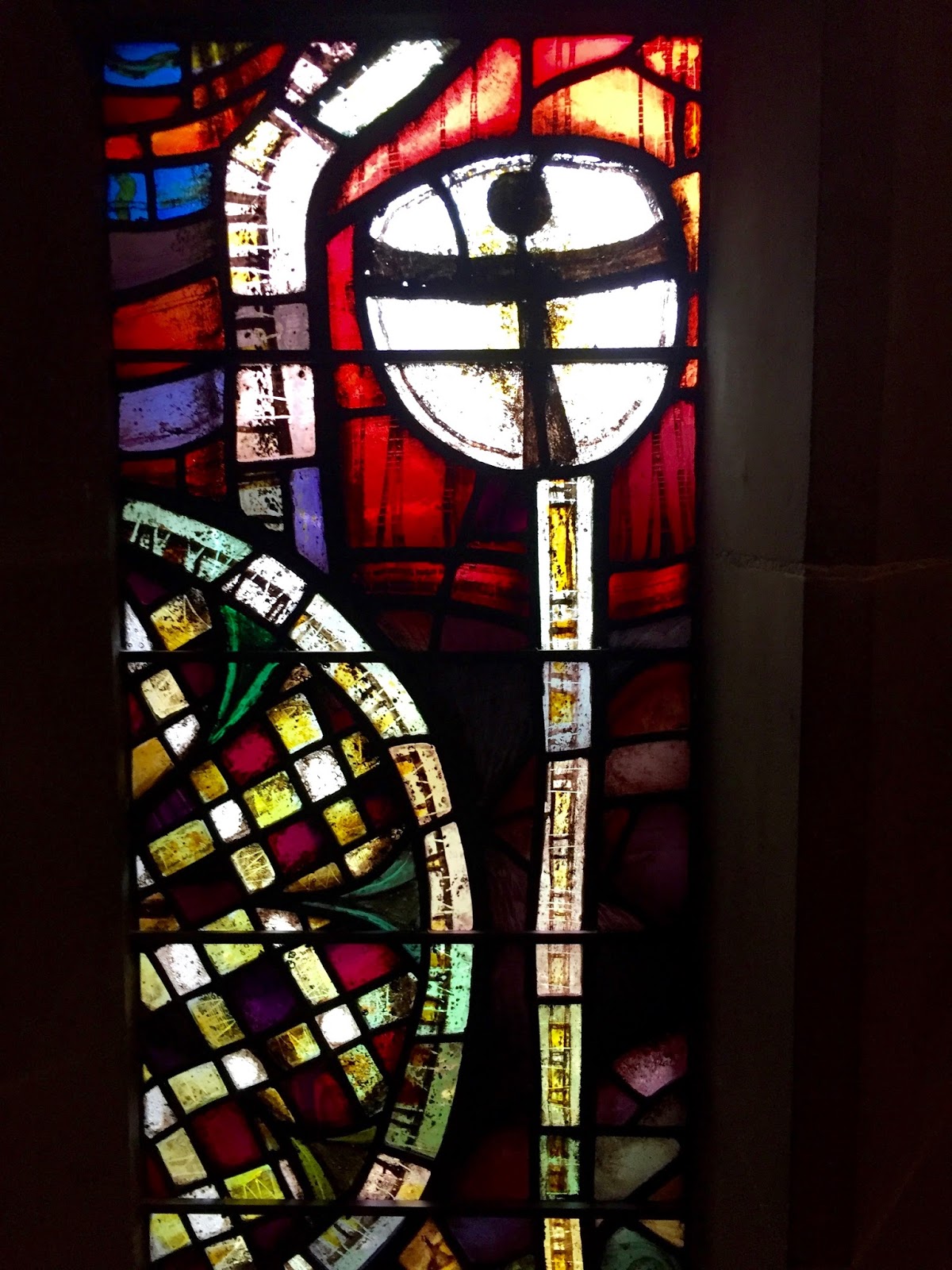
The baptistry and Nave windows were designed be John Piper and painted by Patrick Reyntiens.  


The west screen overlooks the ruins of the original Cathedral and was designed and etched by John Hutton.  The angels and saints represent the continuation of Christianity through the ages. 


"The Plumb Line and the City" by Clark Fitzgerald depicts a city with the plumb line of judgement hanging above it.


The Chapel of Christ in Gethsemane


This is a temporary installment of a series of prints by Monica Petzal.  They represent the twinned cities of Coventry and Dresden and the wider destruction of the cities in Britain and Germany during World War 11.  

http://monicapetzal.com/


Mosaic panels on the floor of the Chapel of Christ the Servant.  


The Piper windows take my breath away.  On a sunny day, they fill the cathedral with light and brilliant color.  The grey walls become a canvas of color reflected from the windows.  Today was a grey and rainy day but the light from the windows was still spectacular. 


For more information about the John Piper windows:


The Litany of Reconciliation

All have sinned and fallen short of the glory of God.
The hatred which divides nation from nation, race from race, class from class,
Father Forgive.

The covetous desires of people and nations to possess what is not their own,
Father Forgive.


The greed which exploits the work of human hands and lays waste the earth,
Father Forgive.


Our envy of the welfare and happiness of others, 
Father Forgive.


Our indifference to the plight of the imprisoned, the homeless, the refugee, 
Father Forgive.


The lust which dishonours the bodies of men, women and children,
Father Forgive.

The pride which leads us to trust in ourselves and not in God,
Father Forgive.

Be kind to one another, tender-hearted, forgiving one another, as God in Christ forgave you.


Wednesday, November 25, 2015

Christmas at Blenheim Palace

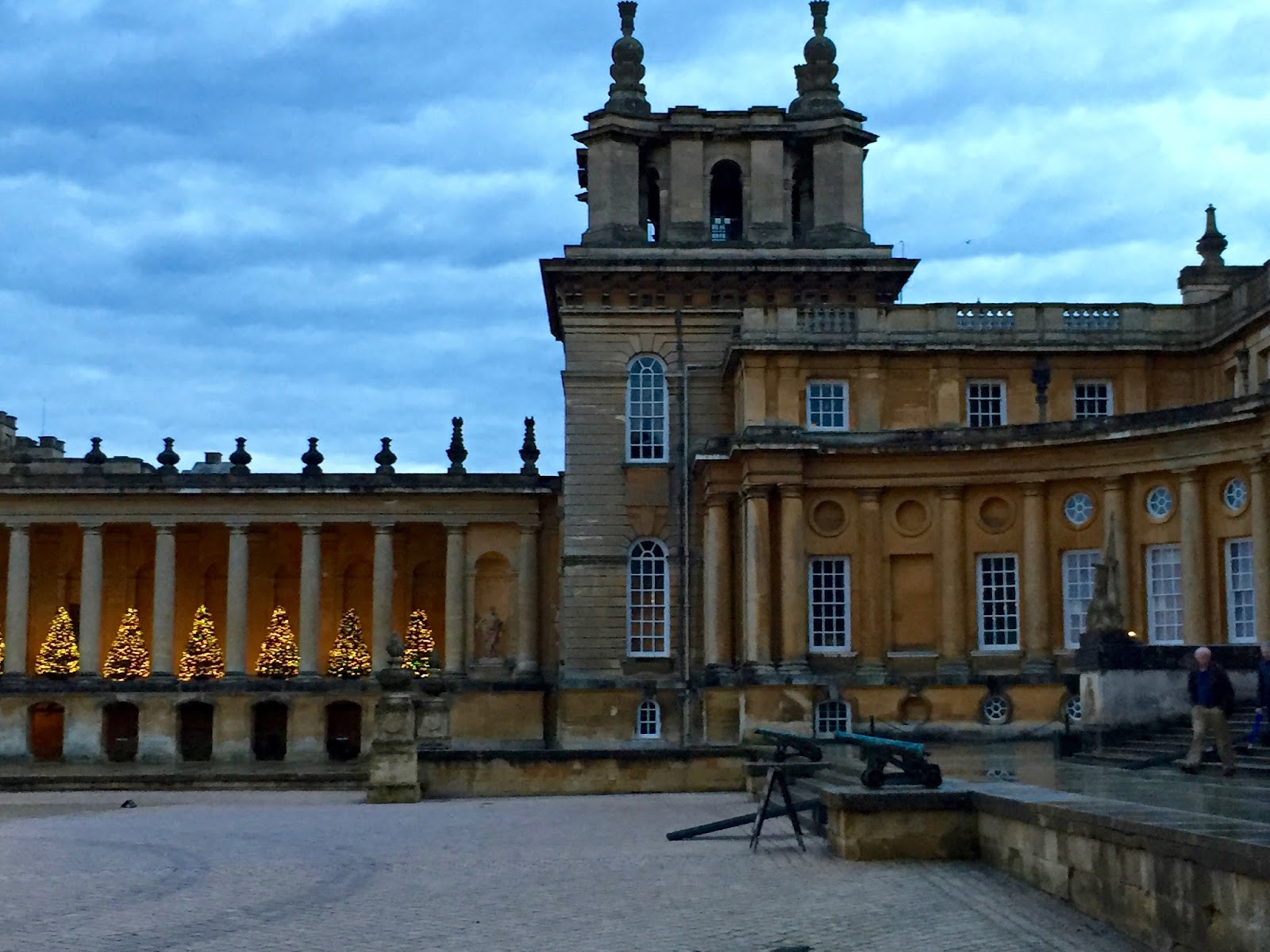
Christmas at Blenheim is beautiful.  The halls are decked with Christmas trees, holly berries, and lights.  Even the statues have festival wreaths on their heads. Home to the 12th Duke and Duchess of Marlborough and the birthplace of Sir Winston Churchill, the palace is always worth a visit.  At Christmas, though, it feels more like a home than a grand palace. 


For more information: