Showing posts with label Cornwall. Show all posts

Monday, June 25, 2018

Lanhydrock

Not far from the town of Fowey in South Cornwall is one of the most beautiful National Trust homes I've yet seen. Lanhydrock is the large former estate of the Agar-Robartes family that dates back to the 1600s. It's is now a magnificent late Victorian preserved country house with extensive servants quarters, beautiful gardens and a wooded estate. The rooms are set up as it was when it was the home of Thomas, the 2nd Lord Robartes, his wife Mary, their ten children, and a staff of 80 at the beginning of the 1900s.


One of the reasons it is such an impressive Victorian home is that In 1881 there was a large fire which damaged much of the house. It was quickly rebuilt as it was before the fire so it preserves the original strict Victorian code which segregated public from private areas, master form servant, young and old, male and female. It is as if Downton Abby or Upstairs/Downstairs has sprung to life again.  It is both glorious in its beauty, decor, and excess, and fascinating in it's history and recreation of a lost world, of life both upstairs and down. The house and the gardens are well worth a visit. 


The original estate was acquired in 1621 by Richard Robartes, the wealthiest man in West Cornwall at that time. Richard's father had amassed a fortune supplying fuel for the tin industry. He and his son, John, continued to build on that wealth through money lending and speculation. Sir John, the grandson, substantially altered Lanhydrock to be an impressive mansion and home for his family.


Sir John married twice. First in 1630 to Lucy Rich who was a staunch puritan. She bore him 5 children. His second marriage was to Letitia, in 1647. She was 17 and he was 42. They had 14 children together.


Several generations later it eventually was inherited by Thomas Charles, the 2nd Lord Robartes, who married Mary Dickinson. The home we see today is furnished as it was when Thomas, Mary, and their 10 children and staff of 80 lived here at the beginning of the 20th century. This was the golden epoch of Lanhydrock house, fortunes were strong and the house was packed with activity, children, and entertainment.

Their good fortune did not last long, though. Of the 10 children born to Thomas Charles and his wife Mary, the oldest son and heir died fighting in France at the beginning of WW and another son never recovered from "shell shock" fighting in the war and eventually killed himself. Of the surviving eight children, only two married and from those marriages only one child was born, a daughter Rachael.

In 1953, the estate was given to the National trust however, the last surviving 8th Viscount continued to live there with his two spinster sisters until his death in 1974. Rachael, the 8th Viscount's only surviving daughter still lives locally and continues to farm in the area.

The house is huge, with 50 rooms open to the public.  What follows is just a sampling of all the rooms that are open to view. 


The Dining Hall


The Kitchen Quarters - a dozen rooms make up the kitchen quarters


The Bakehouse


The Kitchen Scullery


The Dairy Scullery


The Meat Larder


The Smoking Room (early Arts and Craft) 


The Steward's Room


A bedroom


The Playroom


The Nursery


The Nanny's Room


The Nursery's Bathroom


The Luggage Room


Her Ladyship's Bedroom


The Chamberpot Room 


The Boudoir


The Drawing Room


Ghosts in the hallway!


Immediately behind the house is the 15th-century church of St Hydroc.


There are 900 acres of woods and parkland that run down to the Fowey river with walking and bike trails throughout.  


The grounds and gardens are spectacular, especially in late May and in June.


For more information


Address: Bodmin, Cornwall, England, PL30 5AD
Location: 2 m SE Bodmin, off A38 or B3268
Website: Lanhydrock
Email: lanhydrock@nationaltrust.org.uk Phone: 01208 265 950
National Trust - see also: National Trust memberships (official website link)
Location map OS: SX085 636


Lanhydrock House and Gardens


National Trust's Lanhydrock

Wednesday, July 25, 2012

Cornwall Wanderings

John and I just spent a lovely week in Cornwall.  We drove to the southern tip and stayed in the town of Marazion in a little cottage just across from St. Michael's Mount.

The Mount is a great granite crag which rises from the waters of the Bay and is surmounted by an embattled castle, that was originally a Benedict Priory built in the twelfth century
It is known as the sister house of the famous Mont St. Michel in Normandy. The Mount is accessible by a Causeway 2-5 hours each day depending on the state of the tide. 
The castle and former priory is still inhabited b James and Mary St Aubyn who live a 21st century lifestyle within its medieval walls. James is the twelfth generation of the St Aubyn family, who have occupied the castle since the 17th Century.
We arrived in Marazion on a rainy day but shortly before the day ended, the sun peaked out from behind the clouds and from then on we had fairly good weather. 
We spent most of the week exploring the Southwestern coast of Cornwall that is known for it's rugged coves, beautiful beaches, shipwrecks, and a history of smugglers and pirates. 
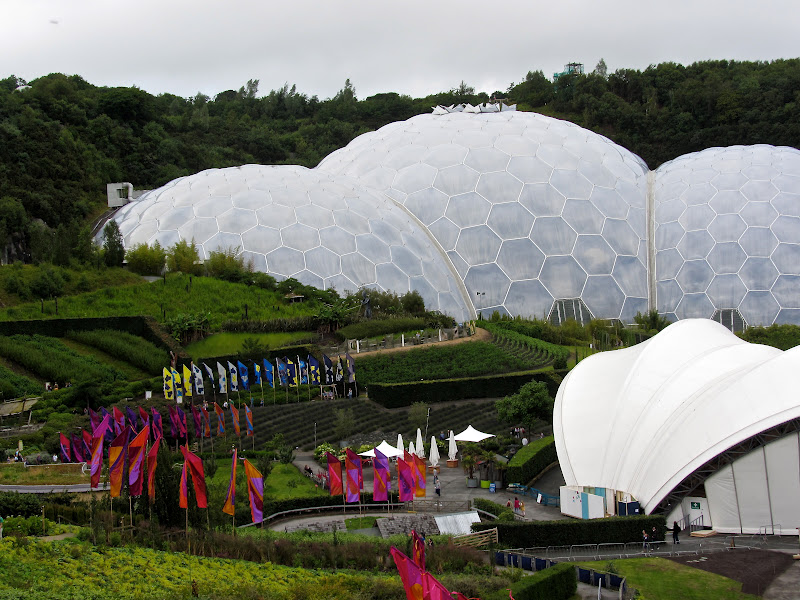
The one rainy day we had we spent at the Eden Project, a former China clay quarry that has been reclaimed as a spectacular garden with two huge biomes.  It claims to have the worlds largest conservatories, and the biggest indoor rainforest.  


It is also living example of regeneration, community building, and sustainable living. It was impressive.
Most days we spent walking parts of the cornish coastal path.  This cove is called Logan Rock.


The South West Coast Path is Britain's longest marked  footpath and national trail -- it stretches for 630 miles.
Beginning at Minehead in Somerset, the path follows the route of the Coastguards who once patrolled the rugged coastline for smugglers and and pirates. The route curls around the entire peninsula of Devon and Cornwall and around the south-western tip of England, following through Dorset to the trail’s end at Poole Harbour.
This photo is for my parents who live near Marconi Beach on Cape Cod. The Cape Cod  beach is named for Italian inventor Guglielmo Marconi. In 1903, the first transatlantic wireless communication originating in the U.S. was successfully transmitted to nearby Marconi Station, a message from U.S. President Theodore Roosevelt to King Edward VII of the the United Kingdom.  Above is the Marconi Station in Cornwall where that first telegraph was received. 
There were some coves and beaches we saw where the water was such a crystal clear blue, it looked like it could be somewhere in the Caribbean.


On day, while hiking, we watched the coast guard do sea rescue training


This is the open-air Minack theatre, constructed on a rocky granite outcrop jutting into the sea. The theatre was created by Rowena Cade, who lived at Minack House overlooking Porthcurno Bay. In 1932 Miss Cade and her gardener made a terrace and rough seating, hauling materials down from the house or up via the winding path from the beach below and The Tempest was performed with the sea as a dramatic backdrop, to great success. Today it is used as a theatre for summer stock production.  
We saw a fun, modern production of Die Fledermaus with the Surrey Opera Co. 
This was the only ship wreck we saw.  
We did see a map that showed 36 shipwrecks in the water within 5 miles of Land's end.  
Land's End
My favorite wizard watching two sharks we saw in this cove
They were basking sharks, which are really whales that look like sharks (they eat krill).  These two were full grown and were roughly 20-25 feet long
It's hard to capture the sense of size of these sharks -- they were BIG!
This was the only photo I could get that showed the size of the shark (or it's fin) in relation to something else.  Even though I know Basking sharks eat krill, they are too big for me to want to share the water with them.


On our last day in Cornwall we toured St Michael's Mount.  We knew the town's choir would be singing a concert on the common that afternoon.  This is the Marazion Apollo Men's Choir.  It was formed in 1904 and reputedly the oldest male choir in Cornwall.  Fishermen by day, singer's by night.  They were great!  http://www.apollo-choir.co.uk or check them out on You Tube.
I loved how the St Michael's Mount causeway appeared and  disappeared with the tide.  I loved the rugged beauty of the coast and the gentle beauty of the farmland and gardens.  I loved the interesting cornish people we met. I loved everything about Cornwall.  Kernow Bys Vyken!  Cornwall Forever!