My sister came to visit us this week and I took her to see my favorite Cathedral -- Coventry Cathedral. Once again, I was struck with the beauty and the spirit of this sacred place. I love all that this ancient and modern Cathedral stands for.
75 years ago this month, the city of Coventry was devastated by a German bombing raid that damaged or destroyed two-thirds of the city. Among the ravaged buildings was the Cathedral of St Michael, which had stood in the center of the city since the late 14th century. After the bombing, only its tower, spire, outer wall and the tomb of its first bishop remained.
Six weeks after the bombing, the Provost of the Cathedral had the phrase "Father forgive" inscribed on the wall of the ruined Cathedral, where it can still be seen today. His vision was to create a sacred space of reconciliation, peace, and forgiveness, despite the atrocities of the war that was engulfing the world at that time.
In 1951 Basil Spence was chosen from over 200 architects to design a new cathedral to replace the destroyed Cathedral of St Michael. Sir Spence chose to keep the ruins of the old cathedral intact – the only competition entrant to do so - and link them to the new cathedral with a high porch. Large artworks were commissioned by Spence and included the baptistery window stained glass by John Piper and Patrick Reyntiens, a bronze sculpture of St Michael by Jacob Epstein, and the tapestry behind the main altar by Graham Sutherland.
John Piper, the creator of the stained glass windows, was appointed as a war artist from 1940-44. In November 1940, Piper persuaded the WAAC committee that he should be allowed to concentrate upon painting bombed churches. As such, he arrived in Coventry the morning after the air raid of November 14, 1940 that resulted in 1000 casualties and the destruction of the medieval Cathedral. Piper made drawings of the Cathedral as it was still smoldering just hours after the bombing. 15 years later, he was commissioned to make the stained glass windows for the new Cathedral.
The new Cathedral was consecrated in 1962. It stands as a physical expression of hope, peace, forgiveness, and reconciliation -- something the world seems in short supply of these days. In 1958, Canon Joseph Poole wrote a Litany of Reconciliation, a confession of of humanity's failings and a prayer for forgiveness, which is read each day at noon in the Cathedral.

The ruins of St Micheal Cathedral at the end of November 1940.

The ruin of the nave wall today with the inscription "Father forgive".

The ruins are undergoing repairs but still stand starkly against the new cathedral and the rebuilt modern town. This is the Choir of Survivors statue by German sculpture Helmut Heinze. It was a gift to the Cathedral from the people of Dresden, Germany, a town nearly totally destroyed by the English and American Allies near the end of the war in 1945.

Looking toward the West Screen

The Tapestry of Christ in Glory was designed by Graham Sutherland and is the world's largest tapestry.

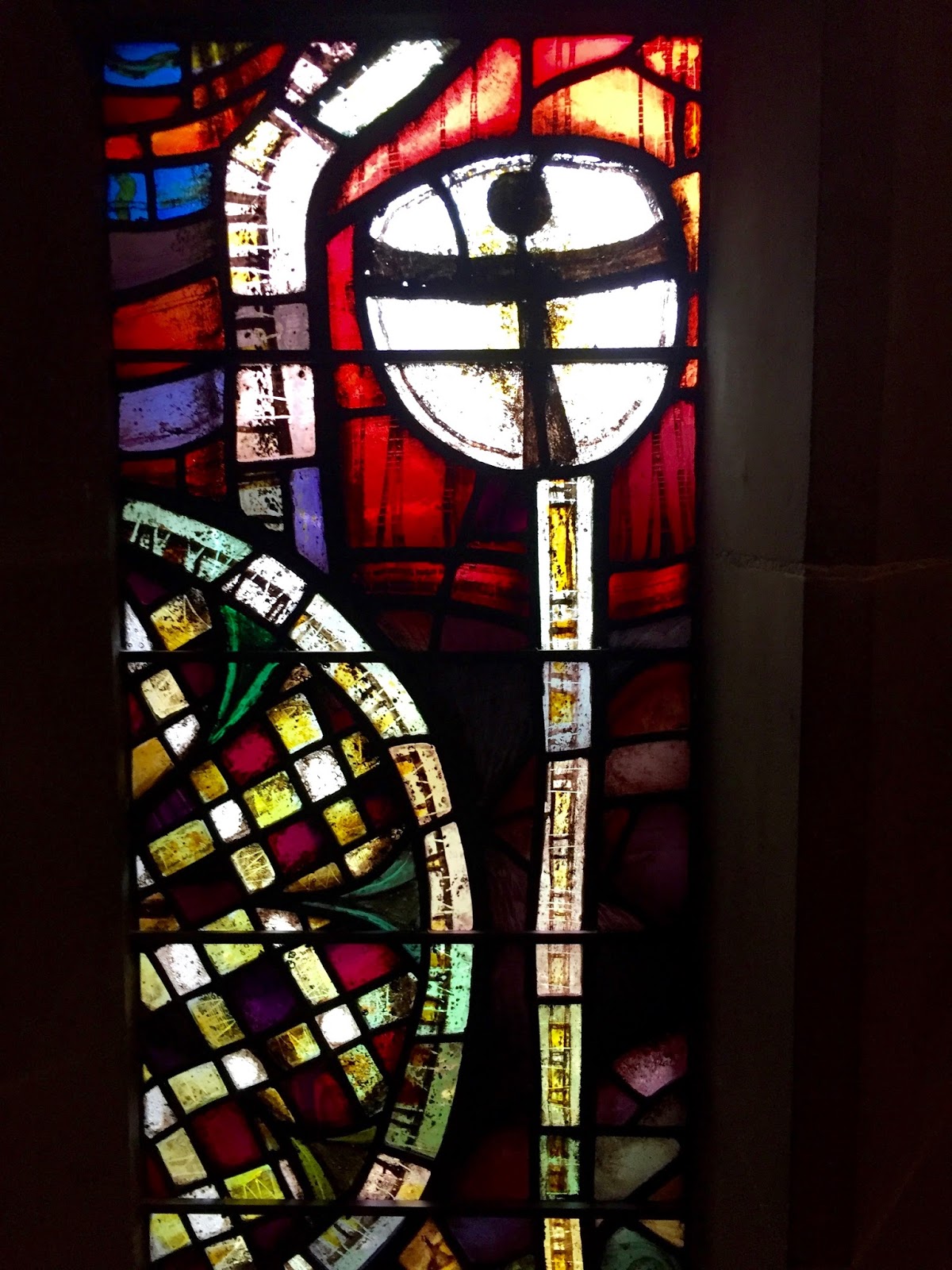
The baptistry and Nave windows were designed be John Piper and painted by Patrick Reyntiens.


The west screen overlooks the ruins of the original Cathedral and was designed and etched by John Hutton. The angels and saints represent the continuation of Christianity through the ages.


"The Plumb Line and the City" by Clark Fitzgerald depicts a city with the plumb line of judgement hanging above it.

The Chapel of Christ in Gethsemane

This is a temporary installment of a series of prints by Monica Petzal. They represent the twinned cities of Coventry and Dresden and the wider destruction of the cities in Britain and Germany during World War 11.
http://monicapetzal.com/

Mosaic panels on the floor of the Chapel of Christ the Servant.

The Piper windows take my breath away. On a sunny day, they fill the cathedral with light and brilliant color. The grey walls become a canvas of color reflected from the windows. Today was a grey and rainy day but the light from the windows was still spectacular.




For more information about the John Piper windows:
The Litany of Reconciliation
All have sinned and fallen short of the glory of God.
The hatred which divides nation from nation, race from race, class from class,
Father Forgive.
The covetous desires of people and nations to possess what is not their own,
Father Forgive.
The greed which exploits the work of human hands and lays waste the earth,
Father Forgive.
Our envy of the welfare and happiness of others,
Father Forgive.
Our indifference to the plight of the imprisoned, the homeless, the refugee,
Father Forgive.
The lust which dishonours the bodies of men, women and children,
Father Forgive.
The pride which leads us to trust in ourselves and not in God,
Father Forgive.
Be kind to one another, tender-hearted, forgiving one another, as God in Christ forgave you.
The Litany of Reconciliation
All have sinned and fallen short of the glory of God.
The hatred which divides nation from nation, race from race, class from class,
Father Forgive.
The covetous desires of people and nations to possess what is not their own,
Father Forgive.
The greed which exploits the work of human hands and lays waste the earth,
Father Forgive.
Our envy of the welfare and happiness of others,
Father Forgive.
Our indifference to the plight of the imprisoned, the homeless, the refugee,
Father Forgive.
The lust which dishonours the bodies of men, women and children,
Father Forgive.
The pride which leads us to trust in ourselves and not in God,
Father Forgive.
Be kind to one another, tender-hearted, forgiving one another, as God in Christ forgave you.
Father Forgive.
Father Forgive.
Father Forgive.
Father Forgive.
Father Forgive.


