Showing posts with label Country Walk. Show all posts

Friday, May 19, 2017

Great Tew and the Falkland Arms

About 35 miles northwest of Oxford is a charming Cotswold town of Great Tew.  In fact, there are three Tew villages: Great Tew, Duns Tew, and Little Dew. All are charming but Great Tew is my favorite.  The village, the landscape and the local 500-year-old pub could not be more picturesque.  


Great Tew is centered around a grand country Estate surrounded by archtypal thatched roof cottages. Spring lambs playing in rolling grassland, horses in the fields, woods with a carpet of bluebells, thatch cottages, a charming pub -- Great Tew is all this and much more. It's one of my favorite places for a country walk and a pub lunch.


The history of Great Tew goes back to the Roman times.  Click here or a brief historical time-line.  SInce the 1960's, the Estate has been owned and managed by the Johnston Family. The Estate enterprises include the in-hand farming operation, an ironstone quarry, the village, the grand estate grounds, and surrounding woods. 


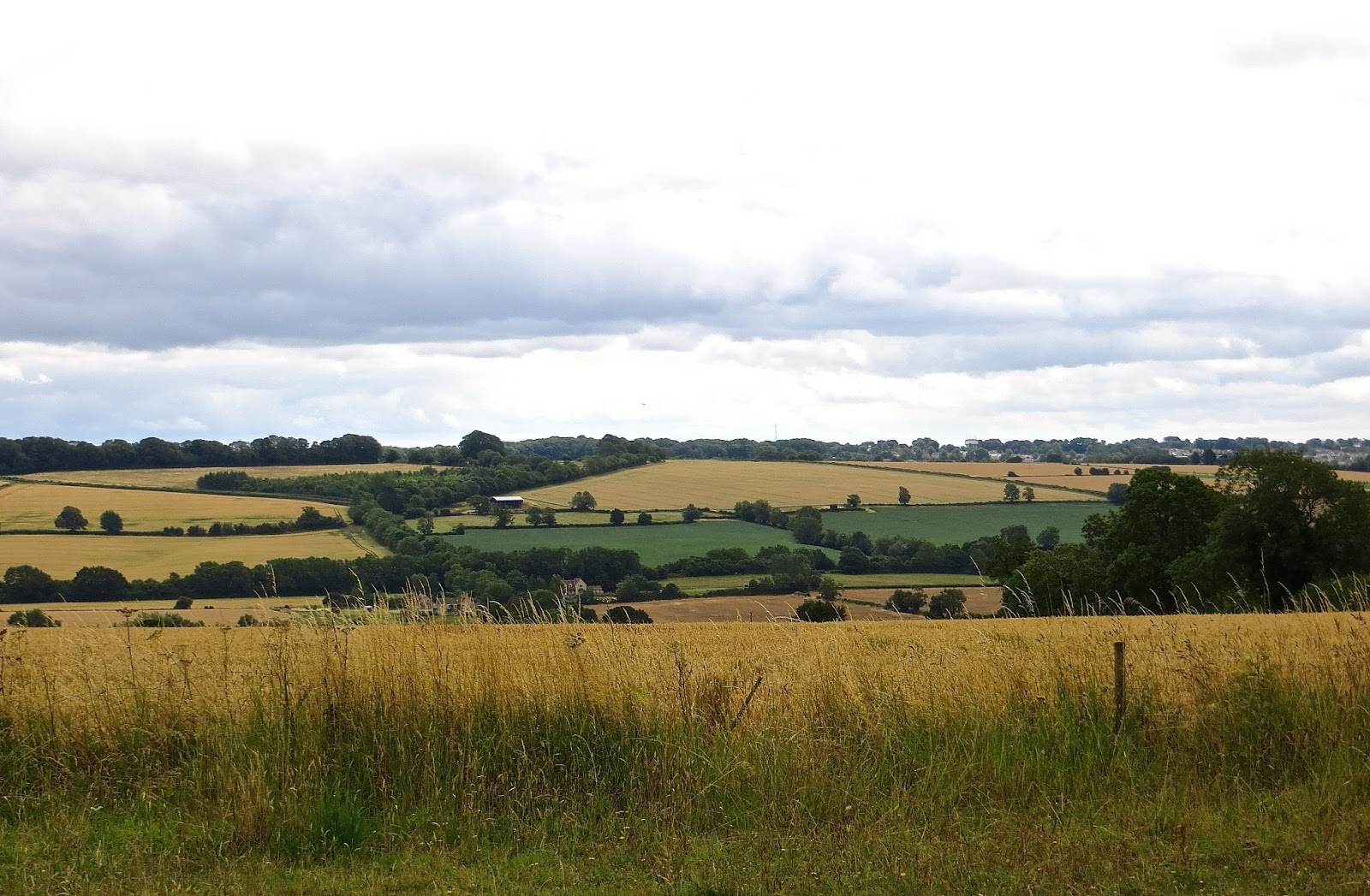
The landscape around Great Tew is stunning. Like so many landscapes in England, it looks absolutely perfectly with every tree perfectly in place.  And, like such landscapes, it was deliberately designed and constructed by a landscape architect.  In this case it was 19th century landscape gardener, John Loudon, who designed this area as part of an extensive park overlooking the Worton Valley. 


 Great Tew is often referred to as a ‘picture book’ Cotswold village because of its thatched cottages and gabled roofs, mullioned windows and colorful gardens and farmland. However, it isn't crowded with tourists like so many other Cotswold villages. In part, that is why I like it so much. 


Great Tew is also home to one of my all-time favorite pubs -- The Falkland Arms. It's a beautiful 16th Century building which has been a traditional, local pub in some form for over 500 years.   


The Pub has flagstone floors, oak beams, ceilings covered with a enormous collection of beer steins, and an inglenook fireplace that has a fire burning in winter.  In warmer weather there is seating in a beautiful garden where you can enjoy the stunning surroundings.


If you are looking for a quintessentially charming English village with one of the most delightful pubs around, you won't won't be disappointed with the village of Great Tew and the Falkland Arms. 


Here is a link to one of my favorite country walks that starts and ends in Great Tew: http://www.theaa.com/walks/the-village-of-great-tew-a-rare-plot-420807 


Thursday, July 21, 2016

Snowshill Lavender, Village, and Manor House

Tucked away in the rolling hills between the charming Cotswold villages of Snowshill and Broadway is a beautiful farm that grows all sorts of lavender. It's a sight to behold, especially when the lavender in full bloom.  Best to come in late June and July when the lavender is at it's peak. It's breathtaking. 


It's a third generation farm that originally grew wheat and barley.  Lavender was first planted here in 2000 and it seems to thrive in the dry limestone cotswold soil.  The farm now grows over 35 different varieties, some 70 miles of rows, and 250,000 plants in total.  


The farm's crops -- Cotswold Lavender --  are gently picked by a special harvester (the only one of its kind in the U.K.) and then steam distilled on the farm and made into unique and all natural lavender products. The farm has a store that sells it's luscious products and gifts as well as a tea room. We had a lunch of a freshly made sandwich and lavender flavored ice cream, which tastes exactly like how lavender smells.


There is a £3.50 fee to wander through the fields and I think it's definitely worth it.  The color and scent of the lavender, combined with the gorgeous rolling Cotswold landscape, makes it an amazing, almost other worldly experience.  


For more information:  Cotswold Lavender Farm


As I walked through the fields this old English song (that dates back to the 17th century) kept running through my head:  


Lavender's blue, dilly, dilly;  lavender's green 

When I am king, dilly, dilly;  You shall be queen 

Who told you so, dilly, dilly;  who told you so?

'Twas my own heart, dilly, dilly;  that told me so.


When the farms lets a field go fallow and rest for a season, they plant it with wild flowers which is a perfect backdrop for the lavender.  


About a mile away from the lavender fields is the charming village of Snowshill, known for its unspoilt beauty and for the views over the Severn Vale to the west. It's tucked away in a bit of a valley sheltered by hills on three sides. 


Not to be missed is Snowshill Manor, owned by the National Trust. It is a typical Cotswold manor house, made from local stone.  The main part of the house dates from the 16th century but part of it was once the property of Winchcombe Abbey dating back to 821. During the Dissolution of the Monasteries in 1539, the Abbey was confiscated by King Henry VIII who then gave it to his 6th wife, Katherine Parr. 


Between the early 1600's and 1919 it had a number of tenants and owners, many of them absentee,  so it gradually fell into a state of disrepair.  
Charles Paget Wade bought estate and rebuilt the ruined manor beginning in 1919. 


More about Charles Paget Wade:  He was born in 1883 and trained as an architect.  In 1911 Wade's father died and he inherited a share in the family business based on sugar estates in the West Indies. 

He served in France during World War and after the war purchased the estate at Snowshill. 


What Snowshill Manor is best known for, however, is not in the architecture but the interior furnishings. The house is a maze of rooms crammed full Wade's decidedly eclectic and eccentric collections of, well, just about everything. 


Wade started collecting things at the age of 7 and eventually built up a collection of more than 22000 items of furniture, clothing, paintings, all sort of other things.  His criteria for selecting items was that the piece was hand made and represented his interest in color, design and good craftsmanship. 


He bought and restored the house, not to live in but to use it for his collection and for entertaining, and he entertained great with flair the likes of contemporaries like Virginia Woolf and Queen Mary.  He lived in a small cottage in the garden and this was his bedroom.   


For 26 years, Wade lived unattached in the house.  He finally married in 1946, at the age of 63, and after that increasingly spent more time at his home in the West Indies.  In 1951 he gave his estate to the National trust and died in 1956. The house and collection are pretty much as they were when he died.  


It is hard to describe the collection at Snowshill. The rooms are filled with fascinating clocks, toys, musical instruments, masks, spinning wheels, weaving and spinning tools, Japanese armor, to name a few. 


For me the house is an absolute surprise.  It's a rambling jumble of delightfully odd, unusual, beautifully designed, and thought-provoking objects. The house and garden are lovely and there are so many interesting things to explore. One could return again and again and see something new and intriguing each time.  


If fascinating clutter and over stuffed rooms aren't to your liking, the garden, grounds and views are lovely. Lavender fields, charming village, National Trust manor, and the most unusual collection and interesting things -- I look forward to returning.  


Thursday, July 30, 2015

The Rollright Stone Circle

I finally made my way to see the Rollright Stones, a stone circle just 30 minutes north of Oxford. While not as impressive as Stonehenge and Avebury, they are lovely in their own right and they are graced by beautiful views of the Cotswold countryside all around them.  It's well worth a wander to see this beautiful place.  

The area consists of three groupings of stones: The Kings Men stone circle (early Bronze Age -- 1500 to 3500 BC), the King Stone (most likely a burial marking), and the Whispering Knights (likely to have been used as a place of burial.)


There are two legends about the origins of the stones. The first legend tells of a king of ancient England who was marching along the ridge with his men (the main circle). They stopped to rest, and while the king (the King Stone) surveyed the way ahead, a group of knights went aside to plot against the king, and were immediately turned to stone.


Another legend goes that while the king was surveying the scene he met a local witch. The witch made a bargain with him, saying, "Seven long strides shalt thou take, If Long Compton thou canst see, King of England thou shalt be." The king, thinking this an easy bargain, replied, "Stick, stock, stone, as King of England I shall be known."  The king took his allotted seven strides, but his view was blocked by the mound known locally as The Archdruids Barrow.
 The witch triumphantly announced, "As Long Compton thou canst not see, King of England thou shalt not be, Rise up stick and stand still stone, For King of England thou shalt be none. Thou and thy men hoar stones shall be, and myself an eldern tree"Whereupon the king and his men became stones, and the witch turned into an elder tree.  


LOCATION
Located on a minor road just off the A34, signposted Little Compton. There is a small fee for entrance to the main circle, but the Whispering Knights and the King Stone can be seen for free. Free parking in a layby, but no toilet or food facilities.
For more information: 

http://www.rollrightstones.co.uk/

 http://www.britainexpress.com/articles/Ancient_Britain/rollright-stones.htm

https://en.wikipedia.org/wiki/Rollright_Stones

http://www.megalithic.co.uk/article.php?sid=140


The view of the valley from the stone circle


Tuesday, April 22, 2014

Bluebell Woods around Oxford

They are back… Bluebell season has begun!


For the next month or so, various woodlands throughout the U.K light up with a brilliant sapphire blue carpet which is simply magical to see, especially on a sunny day.  I wish I could convey how beautiful bluebell woods are.  In my view, bluebell woods should be U.K. National Treasures. 

Park WoodsNuffield Place 

Around Oxford, there are several great places to see the bluebells. Grab your wellies or good walking shoes and visit one of these National Treasures near you. 


(Radley Woods behind our home in Kennington)

 Best places to see bluebells around Oxford:

Harcourt Arboretum:  6 miles south of Oxford   
Bagley Woods: Kennington, 2 miles south of Oxford

Shotover Park:  3 miles east of Oxford center

Magdalen College: City center

Sydlings Copse: 3.5 miles northeast of Oxford

Wytham Great Woods:  4 miles northwest of Oxford

Besselsleigh Common Wood: near Wootton, about 5 miles southwest of Oxford

Foxholes: 4 miles north of Burford

Bradbury Hill: Near Faringdon and owned by the National Trust, is said to be one of the best bluebell woods in the country.

Great Coxwell wood at Colehill

Nuffield Place Woods near Nettlebed

Stoke Wood: (north of Bicester, near J10 of the M40) has lovely bluebells and orchids in the spring. There is a path from the car park suitable for young children or those with limited mobility, or lots of little paths to explore for the more adventurous.


The best time to spot bluebells is the middle of April to the middle of May. They usually bloom in the south first, slowly spreading north towards Scotland as spring progresses.


 Most bluebells are found in ancient woodland where the rich habitat supports a whole host of species. 


Ancient woodland inlcludes woods from the 17th century and some may even be remnants of the original wildwood that covered Britain after the last Ice Age.  


 Have I missed any?  Do you have a favorite bluebell woods nearby? Please let me know.


Interesting facts about bluebells:


  • Nearly 50% of the world’s bluebells can be found in the UK.
  • There are some in western Germany but none in Scandinavian
  • In folklore the bluebell is considered to be the flower of the house goblin.
  • Anyone who wears a bluebell is compelled to tell the truth
  • The bluebell is a symbol of constancy and is probably the origin of the '….something blue…' that a bride should wear on her wedding day.
  • The bluebell is being studied for its medicinal qualities because it contains things called water-soluble alkaloids that could be useful in developing drugs to fight cancer.
  •  In the Bronze Age, people used bluebell glue to attach feathers to their arrows
  • The Victorians used the starch from crushed bluebells to stiffen the ruffs of their collars and sleeves.
  • Legend also says that a field of bluebells is intricately woven with fairy enchantments.
  • Bees can 'steal' nectar from bluebells by biting a hole in the bottom of the bell, reaching the nectar without pollinating the flower.
  • According to folklore, hearing a bluebell ring is a sign of impending death!
  • Bluebell sap was used to bind pages to the spines of books


For more information about Bluebell Woods:

http://www.wildlifetrusts.org/bluebells 


http://www.wildlifeextra.com/go/uk/bluebell-woods.html#cr


http://visitwoods.org.uk/en/visit-woods/things-to-do/nature/Pages/bluebell-images.aspx#.U1aDcuZdWMA